
How to spot rising damp
You can spot rising damp by looking for a distinct tide mark on the lower section of your walls, usually no higher than 1 to 1.2 metres, along with white powdery salt deposits on the brickwork or plaster, peeling or bubbling wallpaper at the base of walls, deteriorating skirting boards and a persistent musty smell. Crucially, rising damp follows an uneven, irregular line rather than a straight one — a perfectly straight horizontal damp patch is more likely to be a leaking pipe.
But rising damp is also one of the most commonly misdiagnosed problems we come across. Penetrating damp, condensation and a bridged damp proof course can all look very similar. The wrong diagnosis leads to the wrong treatment, which means spending money on something that will not fix the problem.
I am Dean Webster. I have been surveying properties across Kent and the South East for over 35 years. Here is what I look for.
What is rising damp?
Rising damp is naturally present moisture from the ground that travels upwards through the walls of your home. It does this by capillary action. The same process that draws water up through a plant stem, or up through a paper towel when you dip the corner in a glass of water.
The reason it should not happen in most homes is the damp-proof course (DPC). This is a physical barrier. Usually, a layer of slate, bitumen, or a plastic membrane is built into the wall at a low level to prevent ground moisture from rising. In modern properties, it is standard. In older homes, especially anything built before around the 1870’s, the DPC might not exist. Or perhaps made from a material that has since deteriorated, or damaged by later building work.
When the DPC fails, or even worse, never existed, moisture finds its way upwards, and rising damp is the result.
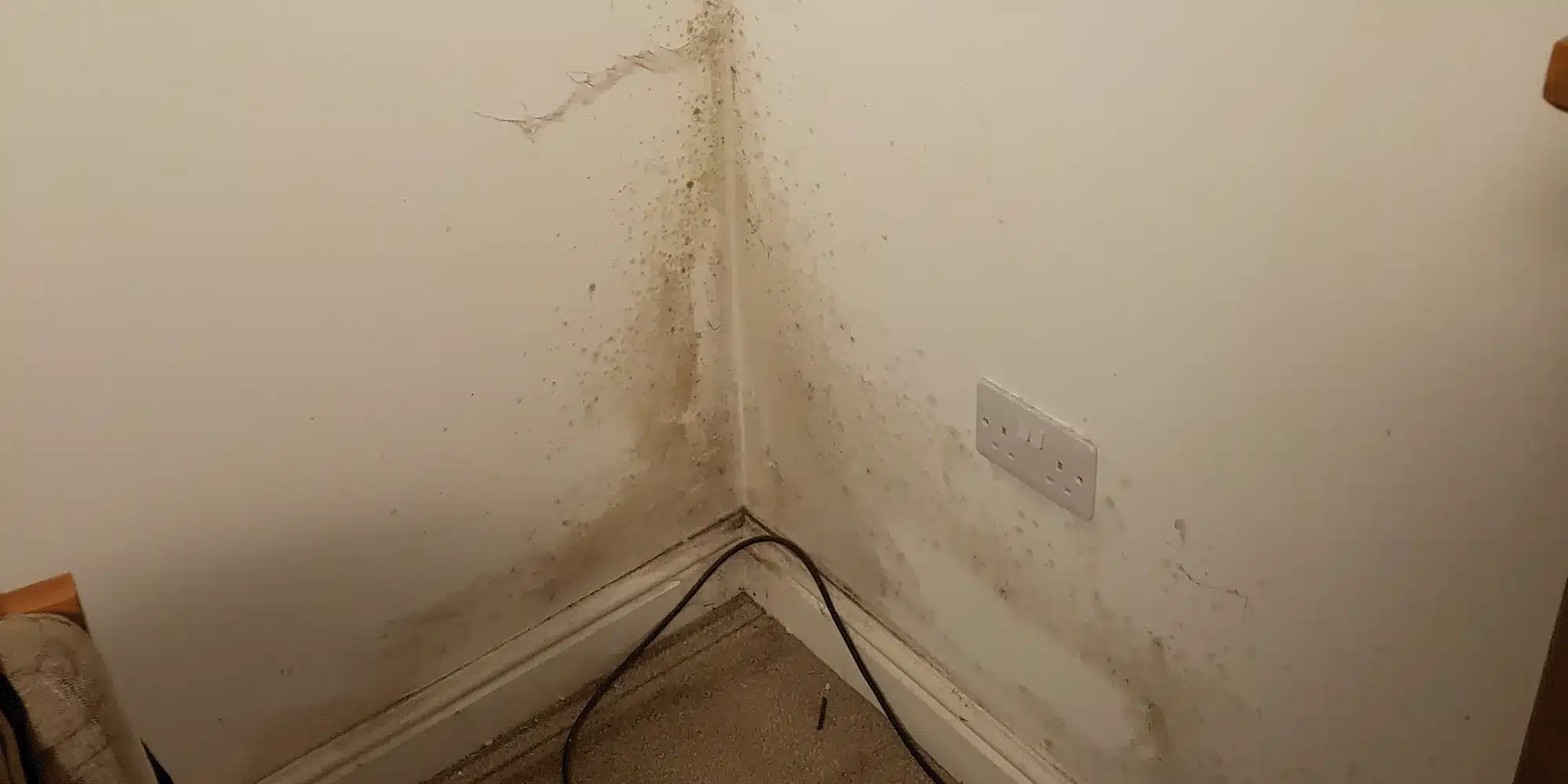
The telltale signs of rising damp
The Tidemark
This is the big one. Look at the lower section of your internal walls, roughly the bottom metre or so. If you can see a distinct horizontal staining, a change in colour, or a visible upper edge to the damp area, that is what we call a tidemark. It is the physical waterline left by moisture as it rises and then evaporates, and it is one of the most distinctive signs of rising damp.
It does not always look dramatic. Sometimes it is just a faint shadow, or a line where the plaster has changed colour slightly. But if it is consistently around the same height across a wall, that is a meaningful clue.
White, powdery deposits on the wall or skirting (efflorescence)
As moisture rises through masonry and mortar, it evaporates at the surface, carrying salts from the ground with it. Those salts are left behind as a white, chalky or crystalline deposit, known as efflorescence.
If you wipe it off, it tends to come back. You might find it on the wall itself, on the skirting board, or at the base of a chimney breast. Efflorescence on its own does not confirm rising damp. It can appear for other reasons, but combined with the tidemark, it is a strong indicator.
Damp or deteriorating skirting boards and flooring
Because rising damp affects the base of walls, skirting boards are often the first thing to suffer. Look for skirting boards that look wrinkled and are pulling away from the wall.
Timber floors near the affected wall may also feel damp to the touch. Or there may be a musty smell coming from beneath the boards. Sub-floor ventilation can help this, but that’s another blog post!
Plaster that is bubbling, crumbling, or hollow
Salt-contaminated plaster, the kind left behind by rising damp, often breaks down over time. Tap the lower section of a wall in an affected room and listen for a hollow sound. Plaster that crumbles easily, has a powdery surface, or is visibly blowing away from the wall beneath it is a common finding in rooms with rising damp.

Mistakes people make trying to spot rising damp
This is where it gets a bit more complicated, and where a professional survey earns its money.
Condensation
Condensation is by far the most common damp problem in UK homes. It is regularly mistaken for rising damp. It tends to appear in the corners of rooms, on outside walls, around windows, and in poorly ventilated spaces like bathrooms and kitchens. Unlike rising damp, condensation often disappears in summer and gets worse in winter. If the mould on your walls is black and appears higher up or in corners, it is more likely to be condensation than rising damp.
Penetrating damp
Penetrating damp comes from outside, through a wall, rather than up from the ground. It is usually linked to a specific defect: cracked render, defective pointing, a leaking gutter, or a blocked downpipe. It can appear at any height on a wall and is often worse in wet weather. If the damp patch seems to track a specific area, near a window, below a parapet, or wherever rainwater runs, penetrating damp is more likely.
A bridged or raised DPC
Sometimes the damp proof course is perfectly intact, but something else is enabling moisture to bypass it. A flower bed built up against the outside wall. Render taken below DPC level. Or debris amassed in a cavity, including cavity wall insulation, can create a moisture bridge that causes symptoms that look exactly like rising damp. This is one of the reasons we always check the external factors as well as the internal signs during a survey.
What should you do if you think you have rising damp?
First, do not panic. Rising damp is a very fixable problem. The treatment is well-established, comes with a long-term guarantee, and a good contractor will sort it properly rather than just paper over the cracks. (And inserting a new DPC is not always the answer.)
Here is what we recommend
Take note of what you are seeing. Height of the damp patch, whether there is a tidemark, what the skirting boards look and feel like, and whether there is a smell. Photos on your phone are helpful when you do speak to someone.
Try our free Damp Diagnostic Tool.
We built this specifically for homeowners who are unsure what they are looking at. Answer a few simple questions, and it will give you tailored guidance based on your answers. No technical knowledge needed, and it only takes a few minutes.
Book a professional survey.
If you are genuinely concerned, the right move is always to get a qualified surveyor in to look at it properly. A Snapshot Survey with us starts from just £95 + VAT, and you will come away knowing exactly what you are dealing with and what the options are.
What we would not recommend is heading straight to a DIY solution or accepting a quote for rising damp treatment based solely on a visual inspection, without moisture readings or a proper diagnosis. We have seen too many homeowners spend money on the wrong treatment, only to find the problem returns.
About South East Timber & Damp
We are a family business based in Woodchurch, Kent. Dean and Annabelle Webster have been running South East Timber & Damp for over 20 years, with a team of qualified surveyors and technicians who cover Kent, South East London, and East Sussex.
Dean holds both the CSRT (Certified Surveyor in Remedial Treatments) and CSSW (Certified Surveyor in Structural Waterproofing) qualifications, the highest recognised credentials in the damp and structural waterproofing industry, and is a member of the Property Care Association.
We are also Which? Trusted Traders, Kent County Council Trading Standards approved, and hold a 9.63 rating on Checkatrade. But our favourite qualification? Over 200 five-star reviews from homeowners who now have dry walls and peace of mind.