
What is the Difference Between Rising Damp and Penetrating Damp?
Rising damp comes up from the ground through the base of a wall via capillary action and can even rise above 1 to 1.2 metres on rare occasions. Penetrating damp comes in horizontally through walls, roofs, windows or doors, usually caused by a defect on the outside of the building such as a blocked gutter, failed pointing or a raised patio or driveway sitting above the damp proof course. In our experience, penetrating damp is far more common than genuine rising damp, and the two are frequently confused. The most important first step is always to identify the source of the moisture correctly before any treatment is decided.
Here is how to tell the difference, what to look out for, and what you should do if you suspect either.
First Things First: What Does a Surveyor Actually Do?
Before we even talk about the two types of damp, it’s worth understanding what a good surveyor’s job really is. It isn’t to turn up and sell you a treatment. It’s to find the source of the moisture. Once we know where the moisture is coming from, the right treatment becomes clear. Without that, you’re just guessing, and guessing when it comes to damp can be an expensive mistake.
What is Rising Damp?
Rising damp is exactly what it sounds like. Water from the ground moves upward through the walls of a building via capillary action. It travels through porous materials like brick and mortar, and typically won’t rise much higher than 1 to 1.2 metres before gravity slows it down.
How to Spot Rising Damp
The signs are fairly distinctive once you know what you’re looking for:
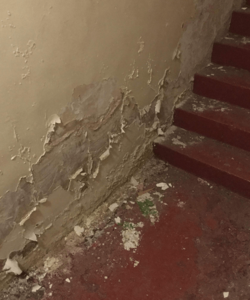
- A tide mark on the external wall where the water has crept up the brickwork
- On internal walls, yellow or brown tide marks at a low level, rarely above 1 to 1.2 metres salty, white residue on the wall surface, which is ground salt being drawn up with the moisture
- Bubbling, flaking or peeling wallpaper
- Rotting skirting boards
- The eventual appearance of black mould spots
One useful pointer: rising damp does not follow a straight line. If you’re seeing a perfectly straight horizontal damp patch, that’s often a sign of a leaking pipe rather than rising damp.
What is Penetrating Damp?
Penetrating damp is moisture that enters a property horizontally, through the walls, roof, or around windows and doors, rather than up from the ground. It’s caused by water finding a way in from outside, and in our experience, it’s actually far more common than genuine rising damp.

How to Spot Penetrating Damp
- Damp patches that appear after heavy rainfall. If it’s seasonal, that’s a big clue
- Damp higher up the wall, above where rising damp would typically reach
- Water staining around windows, door frames or chimneys
- Damp on upper floors or ceilings
- Patches that have a defined edge rather than a gradual tide mark
The Most Common Cause We See: It’s Usually Outside
One of the most frequent causes of penetrating damp we come across isn’t dramatic at all. It’s a blocked gutter, an overflowing hopper pot, or a downpipe that has come away from the wall. Water that should be travelling away from your property is instead running down the outside of your wall and finding its way in.
Our honest advice? Go outside when it’s raining. Have a look. Is water overflowing from the gutters? Are the hopper pots blocked with leaves? You might spot the problem yourself before you even pick up the phone.
Other common culprits we find include:
- New driveways, patios or decking that have been laid too high and now sit above the damp proof course, causing water to run up against the wall and penetrate the property
- Raised flower beds built up against the wall above the DPC level
- Failed or crumbling pointing allowing rainwater to soak into the brickwork
- Cavity wall insulation that has become saturated and is bridging moisture across the cavity
What About the Damp Proof Course?
Most properties have a damp proof course, which is a barrier built into the base of the wall to stop moisture rising from the ground. Over the years, DPCs have been made from slate, engineering brick, lead, felt (bitumen), and modern thick plastic. Download our guide to DPC types here [add your PDF link].
Here’s something that might surprise you. DPCs rarely fail. The modern plastic DPC in particular is very effective and long-lasting. When we ask homeowners why they think they need a new DPC injected, they’ll often say “a friend told me” or “the builder suggested it.” In many cases, the DPC is doing its job perfectly well and the problem is something else entirely.
The age of your property gives us a lot of information. We always ask this before a survey, because it tells us what type of DPC is likely to be in place and what its limitations might be. An older property with a slate DPC, for example, can be susceptible to cracking over time, but even then it’s not always the culprit.
The Big Problem: Misdiagnosis
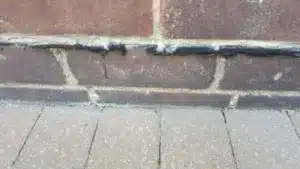
Sadly, over the years we’ve come across many cases where homeowners have had a chemical DPC cream injected into their walls at significant cost, when the real source of moisture was penetrating damp, condensation, or simply a leaking gutter.
We’ve even seen DPC cream injected into the wrong part of the wall, or at the wrong level entirely. It won’t solve the problem. And worse, the real cause is left untreated and continues to do damage.
This is why we refuse to inject a DPC on demand. If a surveyor can’t explain to you exactly why a chemical DPC is needed and where the moisture source has been identified, ask more questions.
Three Questions We Always Ask Before a Survey
When a homeowner calls us, we always ask three things before we even book in:
- How old is the property? This tells us what type of DPC is likely to be in place and what we should be looking for.
- Is the damp seasonal? If it only appears in winter, it’s almost certainly condensation rather than rising or penetrating damp.
- Where is the damp and what does it look like? The location and pattern tell us a great deal about the source before we’ve set foot inside.
What Happens If You Leave It?
We want to be straight with you. Your house won’t fall down. But leaving dampness untreated does have real consequences over time:
- Floorboards and timber can begin to rot, which is a much more costly repair
- Cold, damp walls lose heat more quickly, making rooms harder and more expensive to warm
- The property will develop a damp smell and attract further condensation
- Over time, black mould will establish itself.
So while there’s no need to panic, it is worth getting it looked at.
What We Often Find
In a good proportion of the surveys we carry out, there is actually no major remedial work required. We explain what’s causing the moisture, point out where some basic maintenance is needed such as clearing gutters, improving ventilation or re-pointing a section of brickwork, and let the property dry out naturally over time. That honest advice is worth far more than an unnecessary treatment.
What Should You Do Now?
If you’ve spotted damp in your property, here’s what we’d suggest:
- Walk around the outside of your property, especially in or after rainfall, and look at what’s happening with your gutters, downpipes, ground levels and any recent additions like patios or flower beds.
- Note the pattern and location of the damp inside and whether it seems to be worse at certain times of year.
- Book a survey with a qualified, independent specialist, not someone who arrives with a kit ready to inject a DPC before they’ve even looked properly.
We serve homeowners and businesses across Kent, South East London and East Sussex. Our surveys start from £114 and our CSRT qualified surveyors will give you an honest, straightforward assessment with no scaremongering and no unnecessary work.
Call us: 01732 884535 Web: www.timberanddamp.co.uk Book a Survey Online: https://timberanddamp.co.uk/request-a-survey/
South East Timber & Damp has been helping homeowners and businesses across Kent and the South East since 2005.
We are PCA members, Which? Trusted Traders, TrustMark registered and all work is backed by the GPI guarantee scheme.