
The moment most people think about their basement is October
The heating goes on, the rain returns, and the damp patch they half-noticed in spring has become impossible to ignore. By then, the window for planned, properly specified waterproofing work has largely gone.
Spring is when below-ground spaces give themselves away. A wet winter puts sustained hydrostatic pressure on underground structures, water pushing against walls and floors from all sides.
As temperatures rise and central heating drops off, the evidence of that pressure becomes visible: staining on walls, salt deposits forming on brick, a persistent smell that was not there in summer, patches that appear where the space was dry six months ago. These are not new problems. They are problems that winter has been quietly developing for months.
The good news is that spring is also the ideal moment to act. A survey and specification commissioned now means works can be completed over summer, with the space protected, certified, and ready before the next winter cycle begins.
Why below-ground spaces are different from any other damp problem
A basement or cellar is not simply a room with a damp walls and floors. It is a structure that sits wholly or partly below ground level, which means it faces forces that no other part of a building has to contend with.
Hydrostatic pressure, the force exerted by water in saturated ground, increases with depth. A structure three metres below ground can be subject to water pressure in the region of three tonnes per square metre. At that pressure, surface-applied treatments and off-the-shelf products do not work. The water is not seeping through a gap; it is being driven through the structure by sheer force.
This is also why the distinction between a cellar and a basement matters more than is often appreciated. The terms are used interchangeably, by estate agents, builders, and homeowners alike, but they have different characteristics, different implications in a property transaction, and frequently require different approaches to waterproofing.
Getting the assessment and specification right is not a question of preference. A below-ground waterproofing system that is incorrectly designed or installed can fail entirely, and the cost of rectifying a failed installation routinely runs into thousands of pounds.
Check Out Our Basement Waterproofing Service
What you need to know and why your counterparts’ concerns matter too
If you work with properties that have basements or cellars, whether you are selling them, building within them, or specifying their renovation, what the other professionals around you need to know is as relevant to you as your own concerns. A clear picture of the whole helps everyone make better decisions.
If you are an estate agent
Basement and cellar damp is a disclosure obligation, not just a sales problem. Under the Consumer Protection Regulations and the TA6 Property Information Form, known damp issues affecting below-ground spaces must be declared before a property is listed. That responsibility falls on the agent as well as the seller.
What turns a difficult conversation into a straightforward one is documentation. A below-ground space that has been professionally surveyed, treated by a CSSW-qualified specialist, and certified with a transferable guarantee is a marketable asset.
One without documentation is a liability: buyers’ surveyors will flag it, mortgage lenders will question it, and buyers will use it to negotiate a reduction. The absence of paperwork is one of the most common causes of chain delay in properties with below-ground spaces, and unresolved damp issues have a well-documented tendency to affect achieved prices and undermine buyer confidence at the point when it matters most.
The practical step is simple. Before a property with a cellar or basement goes to market, ask the seller what documentation exists. If the answer is nothing, a professional survey now costs considerably less than the price reduction a buyers’ survey will prompt later.
If you are a builder or construction manager
The most common and costly mistake in below-ground waterproofing projects is bringing the waterproofing specialist in too late. By the time groundworks are under way and programme dates are committed, the options for proper system design have narrowed considerably.
BS 8102:2022, the British Standard governing protection of below-ground structures against water ingress, is clear that a waterproofing specialist should be involved from the outset, ideally at RIBA Stage 2, and no later than Stage 3.
Early involvement means the system is designed around actual site conditions: soil type, groundwater level, intended use of the space, and proximity to sources of vibration such as busy roads or rail lines.
The qualification to look for is the CSSW: Certificated Surveyor in Structural Waterproofing, awarded by the Property Care Association. Without it, the certification issued at practical completion may not be valid for warranty or insurance purposes.
In a well-run project, the waterproofing contractor designs, installs, and certifies the water management system, then hands the prepared space over to the main contractor for insulation, dry lining, and fit-out. Knowing precisely where that handover point sits — and what the certification covers — is important for programme planning and for understanding which guarantees transfer to the end client.
If you are an architect or surveyor
BS 8102:2022 places design responsibility explicitly on the specifier, and the 2022 revision is considerably more demanding than its 2009 predecessor.
A formal risk assessment is now required before any system is chosen, documenting soil type, groundwater conditions, flood risk, the presence of ground gases, and the intended use of the space.
The standard defines four performance grades, from basic car parking at Grade 1a through to a fully habitable, ventilated space at Grade 3. For domestic and commercial habitable basements, Grade 3 is the requirement.
Achieving Grade 3 reliably usually requires a combination of system types rather than a single approach. Type A systems create a physical barrier, what is commonly called tanking.
At South East Timber and Damp Limited we prefer a “belt and braces” approach and mainly specify for the Type C system.
Type C cavity drain membrane systems take a different approach entirely: rather than attempting to block water, a Type C waterproofing system manages it actively, allowing water to enter a drainage cavity behind the membrane, which then channels it to a sump pump station for removal.
Type C systems are now the most widely specified approach for existing structures because they remain maintainable and repairable after installation. Single-system installations remain the most frequently cited cause of specification failure in below-ground waterproofing.
Type C systems require a maintenance schedule: sump pump inspection every six months, full annual servicing, and pump replacement expected approximately every ten years. Clients should receive an operation and maintenance manual at handover and understand those long-term obligations before works begin.
The case for acting in spring, not waiting until autumn
The seasonal argument is practical rather than arbitrary. After a wet winter, underground structures have been under sustained pressure for months.
As temperatures rise in spring, ice that formed in existing cracks expands and then contracts, opening new routes for water ingress that were not present the previous autumn.
Heating drops off, and damp that was masked by consistent warmth through the winter becomes visible. Drainage channels and sump pumps that have worked hard since October need inspection before summer storms put them under pressure again.
Spring also provides the right working conditions for remedial works. Structures can be properly ventilated, materials dry more readily in warmer air, and there is no frost risk to compromise fresh installations. Contractor availability is generally better in spring than in the autumn rush, when reactive maintenance and seasonal demand compete for tradespeople’s time.
Most importantly, spring gives programme lead time that autumn does not. A survey and written specification commissioned in April or May can produce works completed over summer, with the space protected, certified, and signed off well before the next autumn and winter cycle arrives.
Kent’s geology adds its own dimension to this. The county’s mix of chalk, clay, and sandy soils means groundwater behaviour varies considerably across short distances, and many of the region’s older properties, Victorian and Edwardian stock across Maidstone, Sevenoaks, Tunbridge Wells, Tonbridge, and Medway, sit on foundations that predate modern basement waterproofing standards entirely. Cellar waterproofing in Kent is not a niche concern; it is a routine requirement for a significant proportion of the existing housing stock.
A cellar conversion in Rochester
The cellar water management project we carried out at a former public house in Rochester is a useful illustration of what a well-handled project looks like in practice.
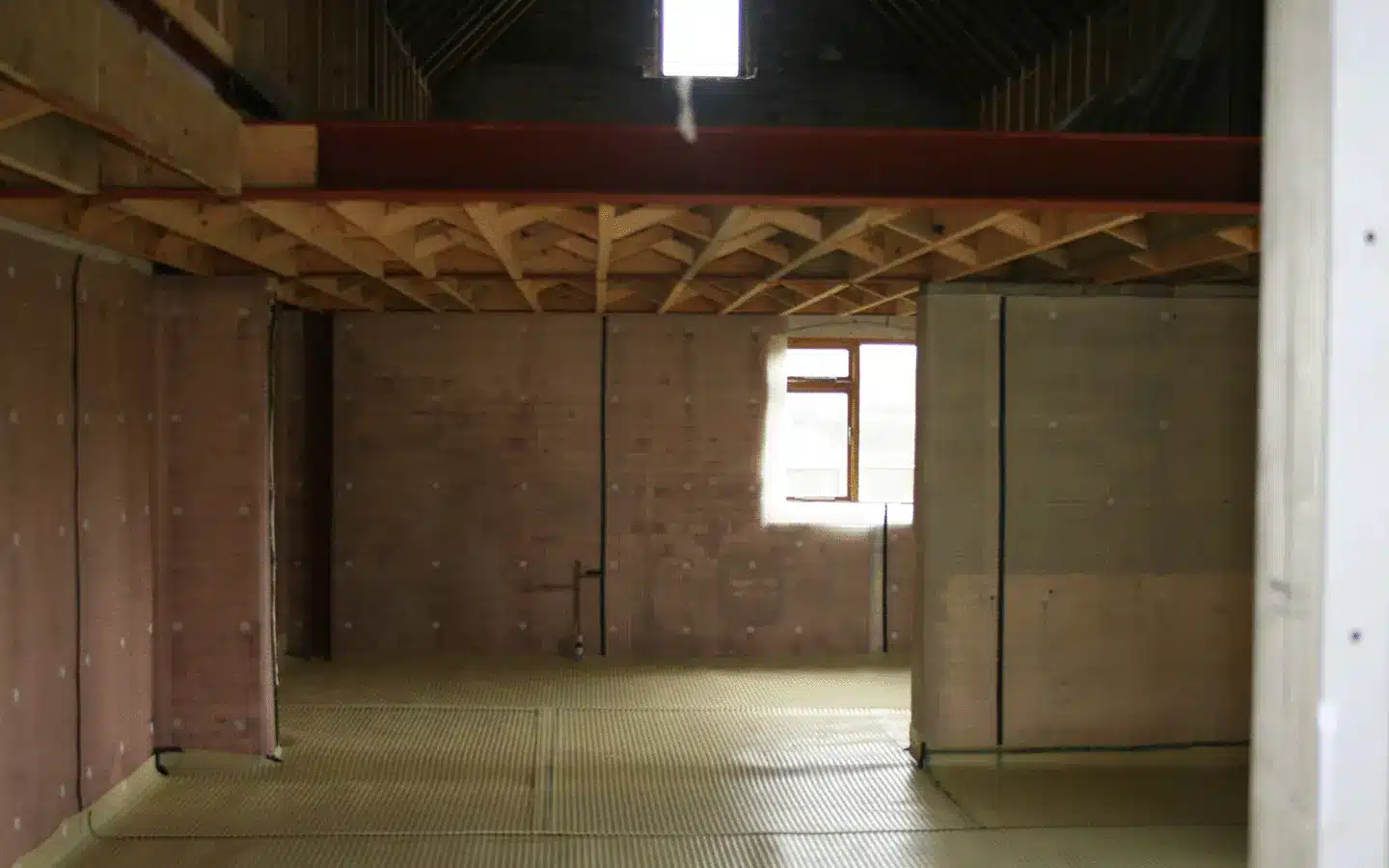
The building was being converted into apartments by a commercial redevelopment contractor. The cellar, which had previously been used for beer storage, had a documented history of water ingress and a single off-the-shelf pump that was found to be non-functional on inspection. Dean designed and installed a Type C cavity drain membrane system, with perimeter drainage channels directing water to a new sump pump station positioned at a strategic point in the floor.
Before handover to the main contractor for dry lining and fit-out, a full flood test was conducted. Water was introduced through hoses to simulate ingress at volume, and the system was observed and verified to be removing water correctly before anything was sealed.
A ten-year certification was then issued, and the main contractor proceeded with the internal completion works.
That clear division of responsibility, from waterproofing specialist through to certification, main contractor for the finish, is the model that produces reliable outcomes, clean programme handovers, and guarantees that hold. It is the approach we use on every project, domestic or commercial.
Damp Proofing a Cellar – case study
Book your survey while the season is right
If you have properties on your books, in your programme, or on your drawing board with basements or cellars, this is the moment to act. Spring surveys translate into summer work, and summer work translates into protected, certified spaces before winter returns.
Dean holds the CSSW qualification from the Property Care Association and is a member of the British Structural Waterproofing Association. We carry out surveys and work across Kent, South East London, and East Sussex, and we are happy to work alongside estate agents, builders, architects, and surveyors at whatever stage of a project you need us.
Get in touch to book a survey at a time that suits you.