
Spotting the signs of penetrating damp early can save you a lot of worry and sometimes a lot of money. I’m Dean Webster, and I’ve spent over 35 years surveying properties across Kent and the South East.” Penetrating damp is one of the problems I get called out to most often, and it’s also one of the most misunderstood. People assume any damp patch on a wall means the same thing, but penetrating damp behaves very differently to rising damp, and knowing what to look for yourself can save you a lot of worry and sometimes a lot of money.
What Are the Signs of Penetrating Damp
The very first thing I look for is decorative spoiling, staining and discolouration on the wall or ceiling. In the early stages, this is usually subtle, just slightly darker than the surrounding paint or wallpaper, not dramatic. It’s only in more severe, established cases that the area starts to actually look wet.
Where the staining is tells you where to look
Where that staining appears on the property points you straig
ht to where the problem’s coming from. If it’s low down around skirting boards, that’s a different investigation to staining higher up around a window, or on a first floor wall. If I see staining around a first floor window, for example, I go outside and check that window and everything above it, including the rainwater goods, guttering and downpipes, since that’s the most likely source.
Once you know roughly where to look, the usual culprits behind the signs of penetrating damp are fairly easy to spot yourself:
- Poor or perished sealant around windows
- Defective pointing, particularly on solid brick or stone walls
- Faulty rainwater goods, guttering and downpipes
- Possible open chimney pots, defective lead details at roofline.
- Internal water carrying systems – i.e., plumbing pipes.
One genuinely useful tip: check your gutters and downpipes while it’s actually raining, not after. Any defect will show itself as water escaping somewhere it shouldn’t during the downpour, and it’s often invisible once things have dried out again.
Does wall type make a difference?
Yes, and it’s not always obvious which way, especially when it comes to how easily the signs of penetrating damp can show up on either type of wall. Solid brick or stone walls, common in properties built before around 1900 to 1910, are more at risk simply because there’s nothing but the wall itself between outside and in.
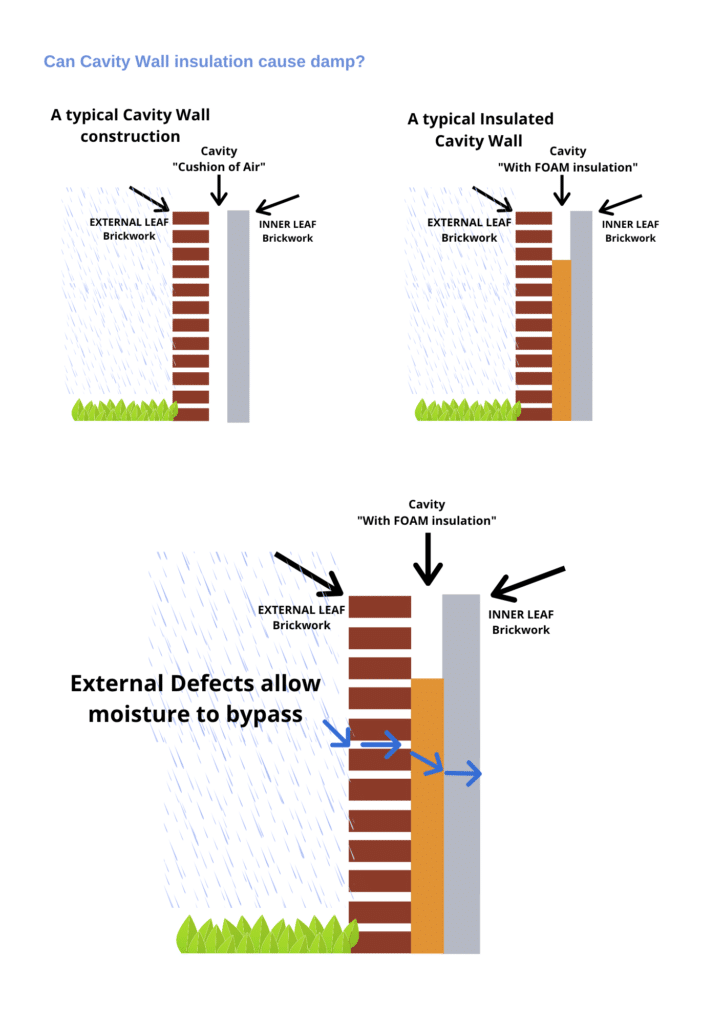
Cavity wall properties are designed differently, the outer layer is allowed to get wet, and the cavity behind it is meant to stop that moisture ever reaching the inside. In theory. But if modern insulation has been introduced into that cavity, which is very common, it can actually bridge the gap and let moisture travel straight through to the inner wall. So a cavity wall home isn’t automatically safe from this, particularly if it’s been insulated at some point. See the detailed image below showing this.

Older Kent properties are more exposed
Generally speaking, properties built after around 1910 to 1920 have cavity wall construction, with some exceptions. Older solid wall properties, which Kent has a lot of, are naturally more exposed to penetrating damp. Neglect, poor maintenance, and simply not staying on top of the basics externally are big contributing factors I see time and again.
Neglect, poor maintenance, and simply not staying on top of the basics externally are big contributing factors I see time and again, and it’s exactly why the signs of penetrating damp show up more in this type of property than any other.
If you’ve just spotted a patch, don’t panic
If you’ve noticed any of the signs of penetrating damp we’ve covered here, don’t panic, just observe and monitor it for a while. If it gets noticeably worse after a spell of rain, that’s a strong sign something external isn’t doing its job properly. Short showers with dry periods in between rarely cause a problem, the wall gets a chance to dry out naturally before it evaporates through to the inside. It’s sustained, heavy rainfall that gives water no time to evaporate, which is when it pushes through.
Whatever you do, get someone who’s genuinely an expert in moisture and construction to look at it, not a general builder. This is a specialist area, and getting the diagnosis wrong at this stage tends to cost more in the long run.
What repair work actually involves
The common repairs are usually exactly what you’d expect once the source is identified, fixing defective guttering and downpipes, sorting out plumbing defects like an overflowing water tank, and repointing using the right material for the building.
That last point matters more than people realise. If your property was originally built using lime mortar, any repointing needs to use a proper lime-based product too, SPAB has good guidance on this if you want to understand why it matters. Using a modern cement-based mix on an old lime-built wall actually works against you, cement acts as a barrier and stops the wall from breathing and drying out naturally the way it was designed to.
The bottom line
If you’ve spotted any of the signs of penetrating damp we’ve covered here, and you’re wondering whether it’s worth calling someone, here’s what I’d want you to know: it’s often not as serious as it first looks. For real peace of mind, our £95 plus VAT entry-level survey is normally money well spent, you’ll walk away knowing exactly what you’re dealing with, one way or the other.
I hope this helps you feel more confident spotting the signs of penetrating damp in your own home. If you’d like to know more about me and my background, you can read more here.
Book a survey or get in touch with the team.